 NFL Stories
 Arizona Cardinals
 Atlanta Falcons
 Baltimore Ravens
 Buffalo Bills
 Carolina Panthers
 Chicago Bears
 Cincinnati Bengals
 Cleveland Browns
 Dallas Cowboys
 Denver Broncos
 Detroit Lions
 Green Bay Packers
 Houston Texans
 Indianapolis Colts
 Jacksonville Jaguars
 Kansas City Chiefs
 Las Vegas Raiders
 Los Angeles Chargers
 Los Angeles Rams
 Miami Dolphins
 Minnesota Vikings
 New England Patriots
 New Orleans Saints
 New York Giants
 New York Jets
 Philadelphia Eagles
 Pittsburgh Steelers
 San Francisco 49ers
 Seattle Seahawks
 Tampa Bay Buccaneers
 Tennessee Titans
 Washington Commanders
 College Football Stories
 SEC
SEC Big Ten
 ACC
ACC Big 12
 Pac-12
 American Conference
 Mountain West
 Sun Belt
 MAC
MAC Conference USA
 FBS Independents
 NBA Stories
 Atlanta Hawks
 Boston Celtics
 Brooklyn Nets
 Charlotte Hornets
 Chicago Bulls
 Cleveland Cavaliers
 Dallas Mavericks
 Denver Nuggets
 Detroit Pistons
 Golden State Warriors
 Houston Rockets
 Indiana Pacers
 LA Clippers
 Los Angeles Lakers
 Memphis Grizzlies
 Miami Heat
 Milwaukee Bucks
 Minnesota Timberwolves
 New Orleans Pelicans
 New York Knicks
 Oklahoma City Thunder
 Orlando Magic
 Philadelphia 76ers
 Phoenix Suns
 Portland Trail Blazers
 Sacramento Kings
 San Antonio Spurs
 Toronto Raptors
 Utah Jazz
 Washington Wizards
 MLB Stories
 Arizona Diamondbacks
 Atlanta Braves
 Baltimore Orioles
 Boston Red Sox
 Chicago Cubs
 Chicago White Sox
 Cincinnati Reds
 Cleveland Guardians
 Colorado Rockies
 Detroit Tigers
 Houston Astros
 Kansas City Royals
 Los Angeles Angels
 Los Angeles Dodgers
 Miami Marlins
 Milwaukee Brewers
 Minnesota Twins
 New York Mets
 New York Yankees
 Philadelphia Phillies
 Pittsburgh Pirates
 San Diego Padres
 San Francisco Giants
 Seattle Mariners
 St. Louis Cardinals
 Tampa Bay Rays
 Texas Rangers
 Toronto Blue Jays
 Washington Nationals
 NHL Stories
 Anaheim Ducks
 Boston Bruins
 Buffalo Sabres
 Calgary Flames
 Carolina Hurricanes
 Chicago Blackhawks
 Colorado Avalanche
 Columbus Blue Jackets
 Dallas Stars
 Detroit Red Wings
 Edmonton Oilers
 Florida Panthers
 Los Angeles Kings
 Minnesota Wild
 Montreal Canadiens
 Nashville Predators
 New Jersey Devils
 New York Islanders
 New York Rangers
 Ottawa Senators
 Philadelphia Flyers
 Pittsburgh Penguins
 San Jose Sharks
 Seattle Kraken
 St. Louis Blues
 Tampa Bay Lightning
 Toronto Maple Leafs
 Utah Mammoth
 Vancouver Canucks
 Vegas Golden Knights
 Washington Capitals
 Winnipeg Jets
 All Soccer Stories
 International Competitions
 UEFA Champions League
 Premier League
 La Liga
 Serie A
 Bundesliga
 Ligue 1
 MLS
MLS College Basketball Stories
 All F1 Stories
 Alpine
 Aston Martin
 Audi
Audi Cadillac
 Ferrari
 Haas
Haas McLaren
 Mercedes
 Racing Bulls
 Red Bull Racing
 Williams
 NASCAR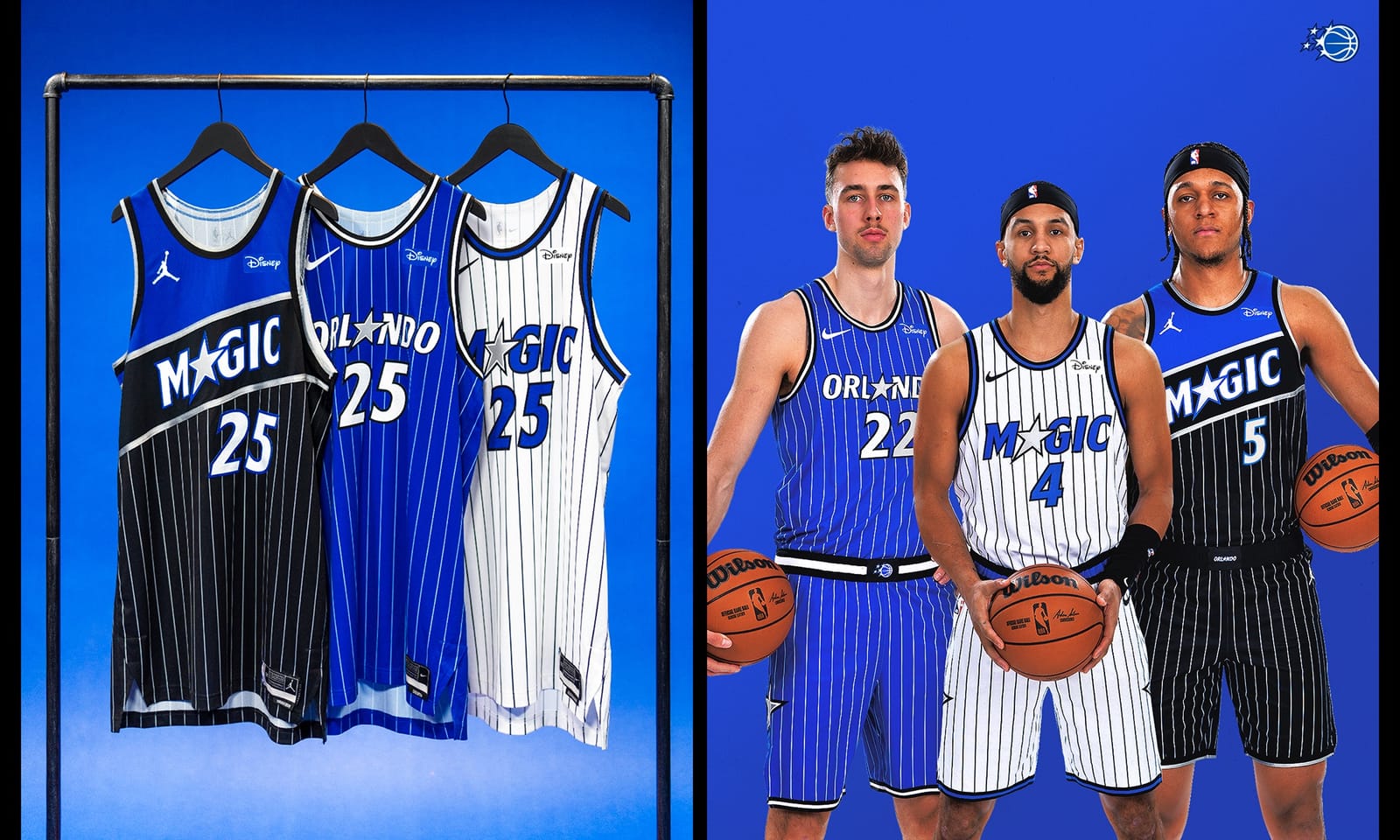
via the Orlando Magic
When the Orlando Magic pulled the wrap off their new identity on June 3, 2025, fans saw a logo, a wordmark, and a set of uniforms. What they did not see was the three-plus years of work behind it, or the fact that almost none of it happened the way most people assume. We sat down with Shelly Wilkes, the Magic's Chief Marketing Officer, to walk through how an NBA uniform actually gets made, from a blank page to the moment a player pulls one on. The answers reshaped a few things we thought we knew, and they explain a lot about the league you watch every night. For the companion pieces, see our breakdowns of who chooses which jersey a team wears each game and who picks NBA playoff jerseys.
It Takes Three to Four Years, and the NBA Owns the Marks
The single biggest misconception about a rebrand is the timeline. This is not a season-long project. It is a three-to-four-year endeavor, and the reason has nothing to do with how long it takes to draw a logo.
"The NBA owns all team identity marks," Wilkes told us. Because the league is a global merchandise brand, every licensee that produces product, starting with Nike and running down to what Wilkes called "every single tchotchke, every single piece of apparel," needs years of runway before a change goes live. If a team flipped its identity on short notice, those manufacturers would be stuck with inventory they could no longer sell. So the calendar is built backward from that constraint.
The Magic actually started the process in 2020 with internal conversations about fan affinity for the existing marks, then moved into a formal research phase. They hired a firm called Navigate to study brand affinity and to look at how logo and identity changes had played out across the NBA and other major brands. "Let's see what's happened in the past, what have been some pitfalls, what have been the great successes," Wilkes said of that early work. The original goal was a launch for the 2024-25 season, the year after the team's 35th anniversary, so the franchise could roll from celebrating its history straight into a new look.
Who Actually Designs an NBA Uniform (It Is Not Nike)
Here is the part that surprised us most. We went in assuming Nike drives the design. It does not.
"The actual design itself, the teams do," Wilkes said. A team's core set, the white Association edition, the colored Icon edition, and the Statement edition, are all team-designed. Nike's role comes on the manufacturing side: once a team hands over a design, Nike makes the tweaks needed to actually build a performance jersey, adjusting where seams and color breaks fall so the garment works on the body. Courts are the same story. Teams design their own courts, within a long list of league guidelines for broadcast, colors, and court lines. The one exception is the NBA Cup court, which is a league template every team receives with only minor team-specific tweaks allowed.
Nike does lead design on league-wide programs that run across all 30 teams, and historically it designed the City Edition uniforms. The NBA's partnership with Nike is fundamental to the success of the uniform program, leveraging Nike's unmatched global footprint to extend the league's and teams' reach around the world. The connective tissue between the teams and Nike is a dedicated NBA department, headed by Christopher Arena, that the Magic worked with heavily for input and direction throughout the process.
This is the rare case where the conventional wisdom is backward. The teams are the authors. Nike is the builder and the league is the approver.
The Agency Rounds, and an Ownership Group That Said "We Can Do Better"
In 2021 the Magic went to market with a request for proposals and selected two brand agencies to develop directions. The brief was specific: create marks that felt holistically new but still felt like the Magic, keep the team's primary ball-and-tail icon in play, and design uniforms to match. The team then ran a full month of focus groups, cycling designs past staff, season-ticket holders, passionate fans, and influencers, before narrowing to a recommendation.
Then, in 2022, the process did something most fans never hear about. When the group brought a recommendation to ownership for approval, ownership pushed back. "We think we can do better," Wilkes recalled them saying. "Let's not rush this." She is thankful they did. The team went back into another round, kept one agency, Skye Design, the sports-identity studio that also created the 2026 MLB All-Star Game marks, which ultimately developed the look that rolled out, and brought in a second agency for fresh direction. Final approval came in 2023, and the finished marks and uniforms were due to the NBA that fall, a full two years before the public ever saw them.
They Were Listening to You the Whole Time
Throughout the process the Magic used social listening, including polls on X and Instagram, to steer the design. The asks that came back were loud and consistent: bring back bold pinstripes, and bring back the star as the A. Fans were telling the team exactly what they wanted without knowing a rebrand was even underway.
The team delivered on both. As a Magic fan looking at the result, the move we love most is the return of the star worked into the A. We also asked Wilkes about the idea of pushing it further, making the dot of the lowercase i a star too. She had been there already. "I looked at a million iterations of that," she said. "It all looks terrible." Too cluttered. The restraint is the point.
Why the Original Magic Logo Only Lives on Throwbacks Now
For the design-obsessed corner of the fan base, there is one recurring wish about any rebrand: just make the originals the everyday look again. To be clear, you can still buy the old marks: the Magic produce throwback merchandise through licensees, and Mitchell & Ness makes the classic jerseys. What the team cannot do is wear those original marks as its current, everyday on-court identity outside of anniversary years, and the reason is a licensing wrinkle most fans have never heard.
"What people don't understand is that those are no longer owned, and we do not have the ability to utilize them," she explained. The production rights to the original uniforms are licensed to Mitchell & Ness through an agreement with the NBA, which is what gives Mitchell & Ness the right to produce Hardwood Classics. Those throwbacks cannot serve as the team's current identity marks. That arrangement exists on purpose, to let collectors and fans celebrate the league's history. So the originals are not gone, they just live in the throwback and anniversary lane now, by design. And as Wilkes pointed out, the team did not want to simply return to the originals anyway. "We had done that. That is a part of our history, and it has its place."
The Blue Changed for a Very Practical Reason
One detail even sharp-eyed fans may not have clocked: the blue shifted. The Magic used to run PMS 2935, a more muted, proprietary blue. They moved to the brighter PMS 2388. The reason is pure practicality. The team's two most visible assets, the uniform and the court, were already effectively PMS 2388 because that is the blue of Nike's fabric. Courts are color-matched to the uniforms: the team sends a physical jersey to the court manufacturer, who mixes the paint to match it exactly. So rather than fight to reconcile two blues, the Magic moved everything to the brighter one fans were already seeing most.
We asked Wilkes about the persistent fan theory that Nike struggles to nail certain colors, the Lakers gold being the usual example. She said the Magic never had a problem getting the colors they wanted. Her best guess on the Lakers situation was a fabric issue: the authentic on-court jersey is built first as a performance garment, and certain colors may simply not render the same on that particular high-performance material. A hypothesis, she stressed, not a fact, but a smart one.
The Business Case Behind Dropping Home Whites
If you have ever been annoyed that the home team no longer reliably wears white, you are not alone, and the answer is money, not aesthetics. We told Wilkes our own playoff tracker found the home team wore white only about a third of the time, and that readers were genuinely up in arms about it.
"If our team is only wearing white at home, where our core fans are coming to the games, how are we really selling and marketing our other four jerseys?" she said. A modern uniform program is four to five jerseys a year. Locking white to home games would bury most of that program. There is a second, sharper reason specific to Orlando: it is a transient market with a lot of visiting fans. "If we play Boston and we're in whites, they get to wear green, their fans show up in green, and it looks like we're helping them tell their story." Wearing color at home denies the visitors that moment.
Worth knowing: the home team picks its jersey schedule after the schedule is released in August, and the road team's uniforms are then mostly determined by those choices. Wilkes runs that selection herself, working with her VP over creative and game entertainment, and theme nights factor in too. We broke down the full economics of the vanishing home white in why NBA teams don't wear white at home anymore.
The Hidden Logistics of Playoff T-Shirt Giveaways
Because we track giveaway colors obsessively, we had to ask about the t-shirts draped over every seat in the playoffs. The Magic's strategy was exactly what we hope for: fans should match what the players are wearing. "We established uniform cadence, and then we ordered t-shirts to match," Wilkes said.
The catch is the logistics, and they are brutal. The team orders around 21,000 shirts per round at roughly three to four dollars each, and it has to place those orders before it knows whether it will even still be playing. That is why the Magic's playoff shirts were generic Magic-branded rather than round-specific: they had to order round-one shirts while still in the play-in. "It was a lot of, if this then that, color of shirt needs to be ordered," she said. To make next year saner, she is considering simply committing to one uniform per round, icon in round one, statement in round two, so the matching gets easier.
Who Is Shelly Wilkes
Wilkes did not set out to run brand identity for an NBA team. She played volleyball in college, which left little time to map out a career, and went to grad school to figure it out. That program, at UCF, was in sport business management, and it is what led her to the Magic, where she has now worked for more than twenty years alongside the same leadership team and creative group. She has two daughters, ages nine and seven, who she hopes are proud of her and will grow up to be lifelong Magic fans.
Her advice for anyone who wants into this world is refreshingly human. "My least favorite question of all time is, what do you want to be when you grow up, because I don't think anybody knows," she said. "Show up every day, be passionate, be excited about what you get to do." For her, the rebrand was a career highlight. "It's a dream job for me."
The Bottom Line on How NBA Uniforms Get Made
The takeaways reorder a lot of fan assumptions. NBA rebrands run three to four years because the league owns the marks and the entire licensee supply chain needs runway. Teams design their own uniforms and courts, not Nike. The originals you want back are licensed to Mitchell & Ness on purpose. The home-white question is a revenue decision, sharpened in Orlando by a transient market. And the giveaway t-shirts you flick popcorn into are ordered weeks before anyone knows the bracket. Our thanks to Shelly Wilkes for the time and the candor. It is the rare look behind a curtain that very few people in sports ever get to pull back.
Frequently Asked Questions
Who designs NBA uniforms?
The teams design their own core uniforms, the Association, Icon, and Statement editions, as well as their own courts. Nike handles the manufacturing side, adjusting seams and color breaks so the design works as a performance jersey, and leads design on some league-wide programs. The NBA owns all team identity marks and approves the final designs through a dedicated department. According to Orlando Magic Chief Marketing Officer Shelly Wilkes, the common assumption that Nike designs the uniforms is backward: the teams are the authors.
How long does an NBA rebrand take?
Three to four years. Because the NBA owns team identity marks and licenses them to manufacturers like Nike for global merchandise, every producer needs years of runway to avoid being stuck with unsellable inventory. The Orlando Magic began their process in 2020-21, had finished marks due to the NBA in the fall of 2023, and launched publicly on June 3, 2025.
Why can't NBA teams just bring back their original logos and uniforms?
The production rights to original uniforms are licensed to Mitchell & Ness through an agreement with the NBA, which is what allows Mitchell & Ness to produce Hardwood Classics throwbacks. As Shelly Wilkes explained, teams no longer have the ability to freely use those original marks themselves. The arrangement is intentional, designed to let collectors and fans celebrate league history through the throwback program.
Why doesn't the home team wear white anymore in the NBA?
It is a business decision. A modern uniform program is four to five jerseys per year, and restricting white to home games would limit a team's ability to sell and market the rest of the program to the core fans who attend games. For the Orlando Magic there is a second reason: as a transient market with many visiting fans, wearing color at home prevents a visiting fan base from showing up in their own colors and dominating the building visually. The home team selects its jersey schedule after the season schedule is released in August.
Does Nike design NBA courts?
No. Teams design their own courts, within a set of league guidelines for broadcast, colors, and court lines. Courts are color-matched to uniforms by sending a physical jersey to the court manufacturer to mix the paint. The only exception is the NBA Cup court, which is a league-wide template that teams receive with only minor team-specific customization allowed.
Why did the Orlando Magic change their shade of blue?
The Magic moved from PMS 2935, a more muted proprietary blue, to the brighter PMS 2388. Their most visible assets, the uniforms and the court, were already effectively PMS 2388 because that is the blue of Nike's fabric, and courts are matched to the uniforms. Moving the entire brand to the brighter blue aligned everything with what fans already saw most often.
How many t-shirts do NBA teams give away in the playoffs?
The Orlando Magic order roughly 21,000 shirts per playoff round at about three to four dollars each. Teams have to place these orders before knowing whether they will advance, which is why playoff giveaway shirts are often generic team-branded rather than round-specific. The Magic's strategy is to match the giveaway color to the uniform the players will wear that game.
Who is Shelly Wilkes?
Shelly Wilkes is the Chief Marketing Officer for the Orlando Magic, where she has worked for more than twenty years. She leads the team's brand and creative work, ran point on the 2025 rebrand, and personally manages the team's game-by-game uniform schedule. She played volleyball in college and holds a graduate degree in sport business management from UCF. She has two daughters, ages nine and seven, who she hopes are proud of her and will grow up to be lifelong Magic fans.