 NFL Stories
 Arizona Cardinals
 Atlanta Falcons
 Baltimore Ravens
 Buffalo Bills
 Carolina Panthers
 Chicago Bears
 Cincinnati Bengals
 Cleveland Browns
 Dallas Cowboys
 Denver Broncos
 Detroit Lions
 Green Bay Packers
 Houston Texans
 Indianapolis Colts
 Jacksonville Jaguars
 Kansas City Chiefs
 Las Vegas Raiders
 Los Angeles Chargers
 Los Angeles Rams
 Miami Dolphins
 Minnesota Vikings
 New England Patriots
 New Orleans Saints
 New York Giants
 New York Jets
 Philadelphia Eagles
 Pittsburgh Steelers
 San Francisco 49ers
 Seattle Seahawks
 Tampa Bay Buccaneers
 Tennessee Titans
 Washington Commanders
 College Football Stories
 SEC
SEC Big Ten
 ACC
ACC Big 12
 Pac-12
 American Conference
 Mountain West
 Sun Belt
 MAC
MAC Conference USA
 FBS Independents
 NBA Stories
 Atlanta Hawks
 Boston Celtics
 Brooklyn Nets
 Charlotte Hornets
 Chicago Bulls
 Cleveland Cavaliers
 Dallas Mavericks
 Denver Nuggets
 Detroit Pistons
 Golden State Warriors
 Houston Rockets
 Indiana Pacers
 LA Clippers
 Los Angeles Lakers
 Memphis Grizzlies
 Miami Heat
 Milwaukee Bucks
 Minnesota Timberwolves
 New Orleans Pelicans
 New York Knicks
 Oklahoma City Thunder
 Orlando Magic
 Philadelphia 76ers
 Phoenix Suns
 Portland Trail Blazers
 Sacramento Kings
 San Antonio Spurs
 Toronto Raptors
 Utah Jazz
 Washington Wizards
 MLB Stories
 Arizona Diamondbacks
 Atlanta Braves
 Baltimore Orioles
 Boston Red Sox
 Chicago Cubs
 Chicago White Sox
 Cincinnati Reds
 Cleveland Guardians
 Colorado Rockies
 Detroit Tigers
 Houston Astros
 Kansas City Royals
 Los Angeles Angels
 Los Angeles Dodgers
 Miami Marlins
 Milwaukee Brewers
 Minnesota Twins
 New York Mets
 New York Yankees
 Philadelphia Phillies
 Pittsburgh Pirates
 San Diego Padres
 San Francisco Giants
 Seattle Mariners
 St. Louis Cardinals
 Tampa Bay Rays
 Texas Rangers
 Toronto Blue Jays
 Washington Nationals
 NHL Stories
 Anaheim Ducks
 Boston Bruins
 Buffalo Sabres
 Calgary Flames
 Carolina Hurricanes
 Chicago Blackhawks
 Colorado Avalanche
 Columbus Blue Jackets
 Dallas Stars
 Detroit Red Wings
 Edmonton Oilers
 Florida Panthers
 Los Angeles Kings
 Minnesota Wild
 Montreal Canadiens
 Nashville Predators
 New Jersey Devils
 New York Islanders
 New York Rangers
 Ottawa Senators
 Philadelphia Flyers
 Pittsburgh Penguins
 San Jose Sharks
 Seattle Kraken
 St. Louis Blues
 Tampa Bay Lightning
 Toronto Maple Leafs
 Vancouver Canucks
 Vegas Golden Knights
 Washington Capitals
 Winnipeg Jets
 All Soccer Stories
 International Competitions
 UEFA Champions League
 Premier League
 La Liga
 Serie A
 Bundesliga
 Ligue 1
 MLS
MLS College Basketball Stories
 All F1 Stories
 Alpine
 Aston Martin
 Audi
Audi Cadillac
 Ferrari
 Haas
Haas McLaren
 Mercedes
 Racing Bulls
 Red Bull Racing
 Williams
 NASCAR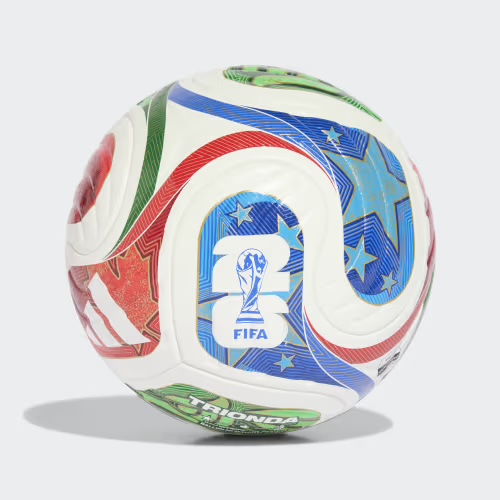
The adidas Trionda. Image via adidas
Every World Cup ball becomes a character in the tournament, and the 2026 edition is no exception. It is called the Trionda, it is made of just four panels, and it is carrying more hidden detail than any match ball adidas has produced. If you have watched a 2026 World Cup match and wondered what the swirling red, blue, and green design means, what is stamped on it, or what the name is supposed to say, here is everything about the ball, along with our design grade.
What "Trionda" Means
The name is a mashup of "tri," three, and "onda," the Spanish word for wave. Triple wave. The three refers to the first-ever three-nation World Cup hosting arrangement between the United States, Mexico, and Canada, and the wave refers to the flowing design that rolls around the ball, a nod to la ola, the stadium wave. One word, and it manages to reference the hosts, the design, and the crowd at the same time. As World Cup ball names go, it is one of the cleaner ideas adidas has shipped.
The Design: Three Colors, Three Icons, One Triangle
The Trionda's surface swirls red, blue, and green waves around a white base, one color for each host nation: red and blue for the United States, green for Mexico, red for Canada sharing the palette. Where the three wave panels meet, they form a triangle at the center, the three hosts converging on one tournament.
Then come the details worth pausing a broadcast for:
- A star stamped for the United States.
- An eagle for Mexico.
- A maple leaf for Canada.
- Gold trim and gold detailing across the panels, a reference to the World Cup trophy itself.
The icons are debossed into the surface, so they read as texture up close and pattern from distance. It is the same trick the best jerseys and uniforms at this tournament use: one clean read on television, a second layer of story when you get close.
Four Panels, the Fewest Ever
Under the graphics, the Trionda is a construction milestone. It is thermally bonded from just four panels, the fewest of any World Cup ball, continuing a decades-long slide from the 32-panel classics of the twentieth century. Fewer panels mean fewer seams, so adidas engineered the remaining seams deep and laid debossed lines across the surface to keep enough drag for a stable, predictable flight. The textured icons are doing aerodynamic work too, adding grip for wet conditions and helping the ball hold its line through the air.
The Chip Inside
The Trionda also carries adidas' connected ball technology: a motion sensor chip mounted in a special layer inside one of the four panels, reporting ball data at 500 times per second. That feed goes to the video match officials in real time and, combined with player tracking data, powers the semi-automated offside calls you see resolved in seconds at this tournament. When a 2026 World Cup offside decision flashes up almost instantly, the ball itself supplied half the evidence. And it is not just offside: as the clip below shows, the system can even flag a ball that was never placed properly on the corner arc before the kick was taken.
Our Grade: A-
We grade the Trionda an A-. The concept is genuinely strong: a three-host tournament is awkward to brand, and this ball solves it with one word, one triangle, and three icons instead of a committee collage. The gold trophy detailing is a classy touch, the wave energy suits a tournament being played in front of the loudest crowds in North American soccer history, and the four-panel engineering story gives it substance beyond the graphics. It stops short of an A+ because the swirl reads busy at certain camera angles, especially in tight shots against grass, where the classics in this category, the Telstar, the Azteca, and the Jabulani, whatever you think of its physics, each held one iconic visual note. The Trionda holds three at once, and it occasionally sounds like it. Still: this is a top-tier World Cup ball, and it will age well.
For how the rest of the tournament's visual identity is holding up, our live 2026 World Cup jersey tracker grades every kit matchup of all 104 matches, and our scorebug review covers the broadcast package the Trionda flies across.
Get the Trionda
The Trionda comes in several versions, from the full Pro match ball used in the actual tournament, the one with the chip layer and thermally bonded panels, down to replica training and mini sizes that keep the same wave design at a fraction of the price. If you want the exact ball being played at this tournament, look for the Pro. If it is for the backyard or a display shelf, the replicas photograph nearly identically.
Some links on this page earn us a commission at no extra cost to you.
Frequently Asked Questions
What is the 2026 World Cup ball called?
The official match ball of the 2026 World Cup is the adidas Trionda. The name combines "tri," meaning three, with "onda," Spanish for wave, referencing the three host nations, the United States, Mexico, and Canada, and the wave-like panel design.
What do the symbols on the Trionda mean?
Each host nation gets an icon on the ball: a star for the United States, an eagle for Mexico, and a maple leaf for Canada. The red, blue, and green waves carry the three countries' colors, they meet in a triangle at the center of the design, and the gold detailing references the World Cup trophy.
How many panels does the Trionda have?
Four, the fewest of any World Cup match ball. The panels are thermally bonded rather than stitched, with deep seams and debossed surface lines engineered to keep the ball's flight stable despite the low panel count.
Does the 2026 World Cup ball have a chip in it?
Yes. The Trionda carries a motion sensor inside one of its panels that measures ball movement 500 times per second and sends the data to match officials in real time. Combined with player tracking, it powers the tournament's semi-automated offside system.
Who makes the 2026 World Cup ball?
Adidas, which has made every World Cup match ball since 1970. The Trionda was unveiled in October 2025 and is used across all 104 matches of the 2026 tournament.
Where can you buy the 2026 World Cup ball?
The adidas Trionda is sold through adidas, Fanatics, Amazon, and most major soccer retailers. It comes in multiple versions: the Pro match ball, the same specification used in tournament matches, plus cheaper replica, training, and mini sizes that carry the same red, blue, and green wave design.
Is the Trionda a good ball?
Players and coverage through the group stage have treated it as a fast, stable ball in flight, and its four-panel construction with textured surfaces is designed for consistency in wet conditions. On design, we grade it an A-: a clean solution to the three-host branding problem, docked slightly for how busy the swirl reads in tight shots.
The Bottom Line on the Trionda
The Trionda is a three-country tournament compressed into one object: red, blue, and green waves meeting in a triangle, a star, an eagle, and a maple leaf pressed into the surface, gold trim borrowed from the trophy, and a chip inside feeding the offside system. It is the fewest-panel World Cup ball ever made and one of the smarter-branded ones, an A- design that solves a genuinely hard brief. Sixty years from now it will look exactly like 2026, which is the whole job of a World Cup ball.