Michigan's winged helmet is one of the most recognizable helmets in college football, and it started as a piece of padding. In 1938 new coach Fritz Crisler took a stock leather helmet whose design already had a wing shape stitched over the crown, painted it maize and blue, and sent his team out in it. The reason was practical: he wanted his passers to be able to spot their receivers downfield.
Michigan has kept the wings ever since, through the switch from leather to plastic in 1948 and into an 88th season in 2026. Michigan hosts UCLA today, Saturday, November 21, at 3:30 p.m. ET on CBS, and the wings are on the field again. Here is where they came from, what Michigan wore before them, and what the record says about the first game.
Quick Answers
- Why does Michigan's helmet have wings? The wing shape came from a Spalding leather helmet, where it was a padded piece that bound the ear flaps to the crown. Fritz Crisler painted it maize over blue in 1938 so his passers could pick out receivers downfield.
- When did Michigan start wearing the winged helmet? 1938, Crisler's first season. It debuted on October 1, 1938, in a 14-0 win over Michigan State.
- Who designed it? Crisler, who had introduced a similar helmet at Princeton in 1935. He called it "the same basic helmet I had designed at Princeton," as quoted by mgoblue.com.
- What did Michigan wear before? A plain black leather helmet, the same basic design the team had worn since the 1920s.
- What did the helmet cost? The Spalding FH5 was advertised at $10.00 in the 1937 Official Intercollegiate Football Guide, in "tan and black leather."
- Did it work? Michigan's passing yardage nearly doubled from 1937 to 1938, and its interceptions were cut nearly in half, according to the Bentley Historical Library.
- When did the wings go on a plastic helmet? In 1948, when Michigan adopted a molded plastic helmet and kept the winged design.
- Our take (opinion): It is the best helmet in college football, and the reason is that it was never designed to be a logo.
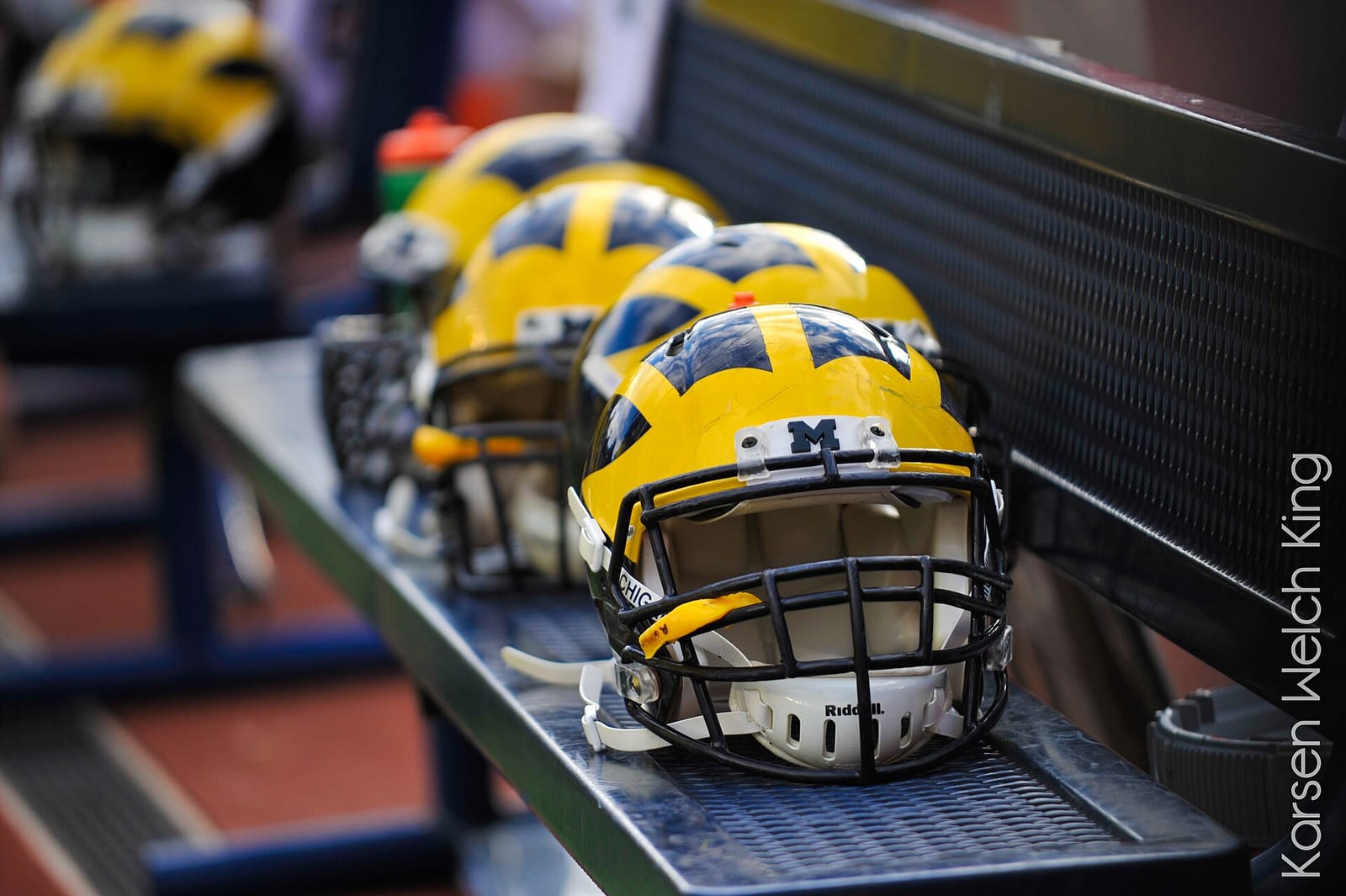
Winged helmets on the Michigan bench, Indiana at Michigan, November 1, 2014. Photo: Maize & Blue Nation, via Wikimedia Commons, CC BY 2.0
1938: A New Coach From Princeton
Herbert "Fritz" Crisler came to Ann Arbor in 1938 after six seasons as Princeton's head coach, and he coached Michigan through 1947, according to the Bentley Historical Library, the University of Michigan's archive. At Princeton he had already put his teams in a helmet with a winged design, in 1935. When he arrived at Michigan, he wanted the same thing.
"Michigan had a plain black helmet and we wanted to dress it up a little," Crisler said, as quoted by mgoblue.com. He described the result as "the same basic helmet I had designed at Princeton."
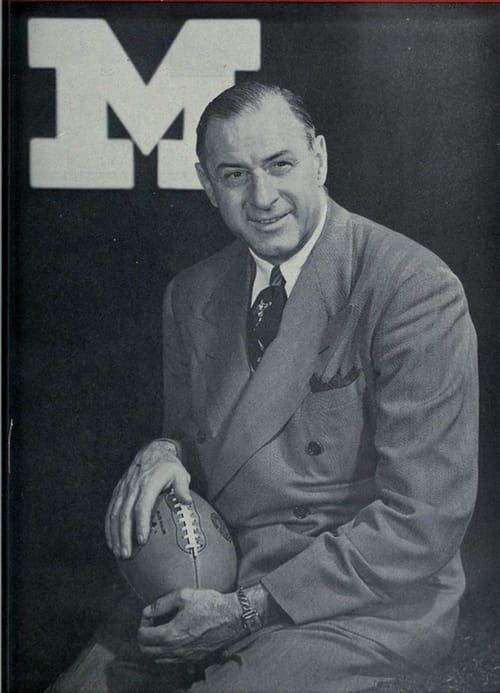
Fritz Crisler, Michigan's head coach from 1938 to 1947, in the 1948 Michiganensian. Photo via Wikimedia Commons, public domain
What Michigan Wore Before The Wings
Before 1938, Michigan wore a basic black leather helmet, the same design it had used since the 1920s. The Bentley's history points out that many schools wore the same black or brown helmet, so nothing on a Michigan player's head said Michigan.
One survivor of that era sits in a presidential museum. The Gerald R. Ford Presidential Museum holds a leather helmet it says is "believed to have been worn by Gerald Ford while playing for the University of Michigan, 1932-1934." Those were the years just before the wings. The helmet is embossed "MOS / Spaulding," the museum records.
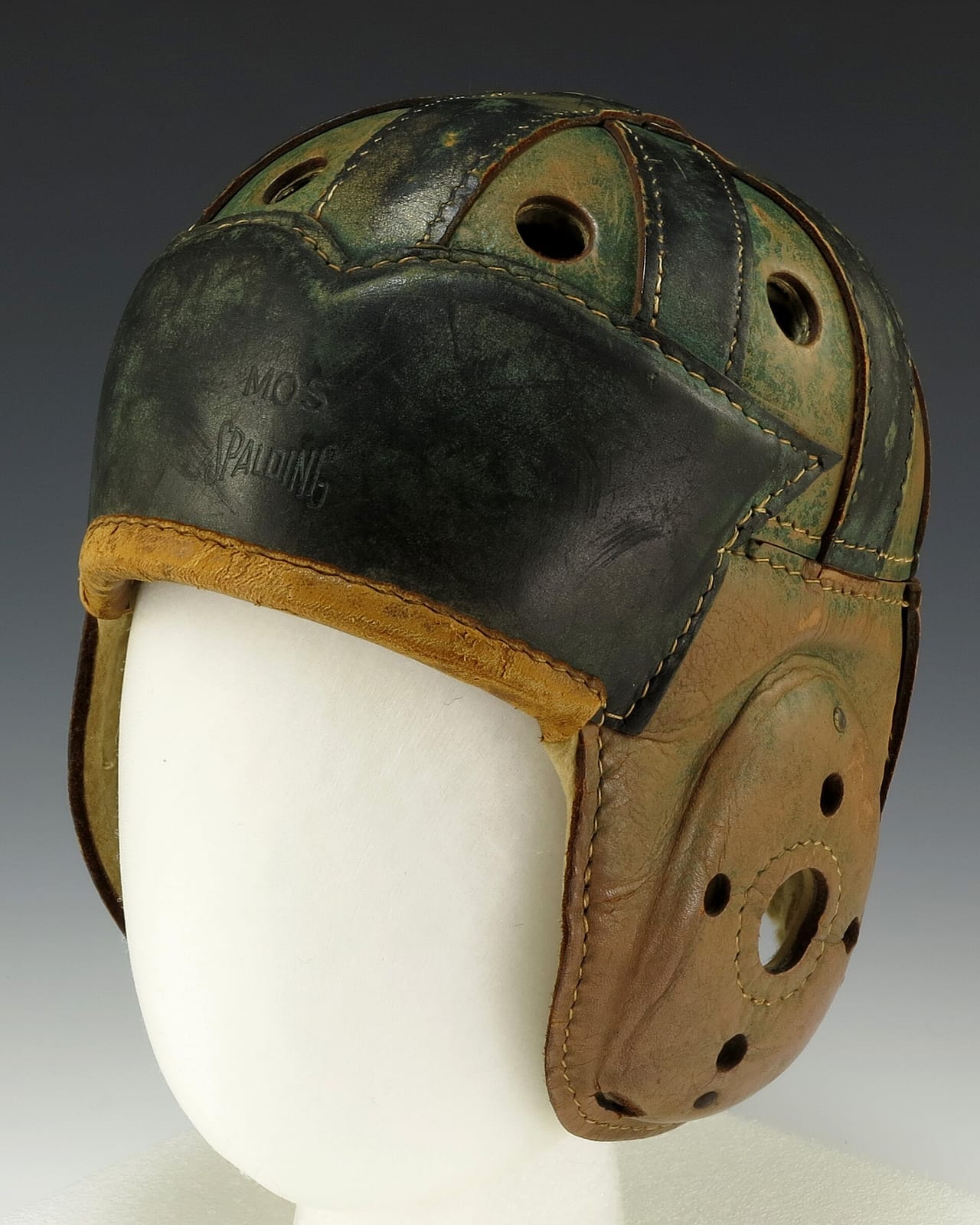
A Michigan leather helmet believed to be Gerald Ford's, 1932-34, from before the wings. Photo: Gerald R. Ford Presidential Museum, via Wikimedia Commons, public domain
The Wings Started As Padding
The wings were not drawn for Michigan. They came with the helmet. The model Michigan used was the Spalding FH5, first advertised in the 1937 Official Intercollegiate Football Guide in "tan and black leather" at $10.00 each, according to the Bentley Historical Library.
On the FH5, the wing was a structural piece. The Bentley's account says it "provided additional protective padding and helped bind the earpieces to the crown." Michigan's FH5s came only in black and tan. Crisler's change in 1938 was to paint the helmet: maize on the wing piece and blue on the rest. The shape was Spalding's. The colors were Crisler's.
That is the part people miss: the wings on Michigan's helmet today trace a piece of a 1930s leather helmet, kept long after the leather was gone.
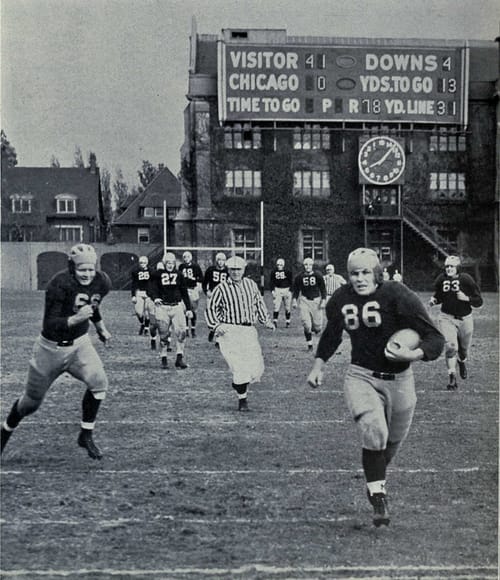
Bob Westfall in the winged leather helmet against Chicago, 1939, from the 1940 Michiganensian. Photo via Wikimedia Commons, public domain
Why Crisler Wanted Bright Wings: Finding Receivers
Crisler ran the single wing, an offense where the halfbacks did most of the passing. In a crowd of players in the same dark helmets, a passer had a hard time finding the right man downfield. Bright maize stripes over the crown of every Michigan helmet gave the halfbacks something to look for.
Why put them on everyone? Some teams of the era put colored helmets on their receivers only. The Bentley history records Crisler's view of that idea: it helped the defense just as much, since defenders could pick out the receivers too. So the whole Michigan team wore the wings.
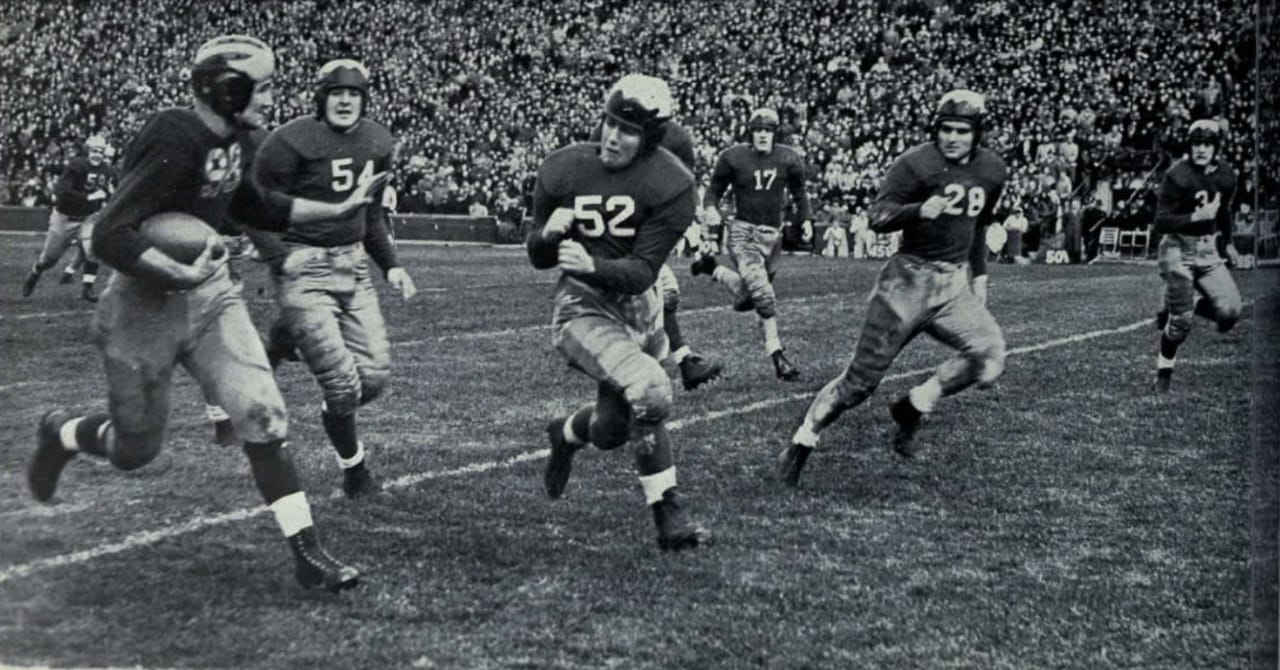
Tom Harmon (98), one of Crisler's passing halfbacks, against Yale in October 1939, from the 1940 Michiganensian. Photo via Wikimedia Commons, public domain
October 1, 1938: The First Game, Against Michigan State
The winged helmet debuted in the 1938 opener, on October 1, against Michigan State. Michigan won 14-0 on two touchdown runs by Paul Kromer, according to the Bentley Historical Library and mgoblue.com.
Two details from that day are easy to miss. First, the Bentley notes that none of the newspaper accounts of the game mentioned the new helmet. The helmet Michigan is now known for arrived without a headline. Second, Michigan was not the only winged team on the field. Michigan State had adopted its own Spalding winged helmet several years earlier, according to the Bentley.
The results showed up over the season. Michigan's passing yardage nearly doubled from 1937 to 1938, and its interceptions were cut nearly in half, the Bentley and mgoblue.com both report. The helmet was not the only change in 1938 (Michigan had a new coach), but it was built to help the passing game, and the passing game improved.
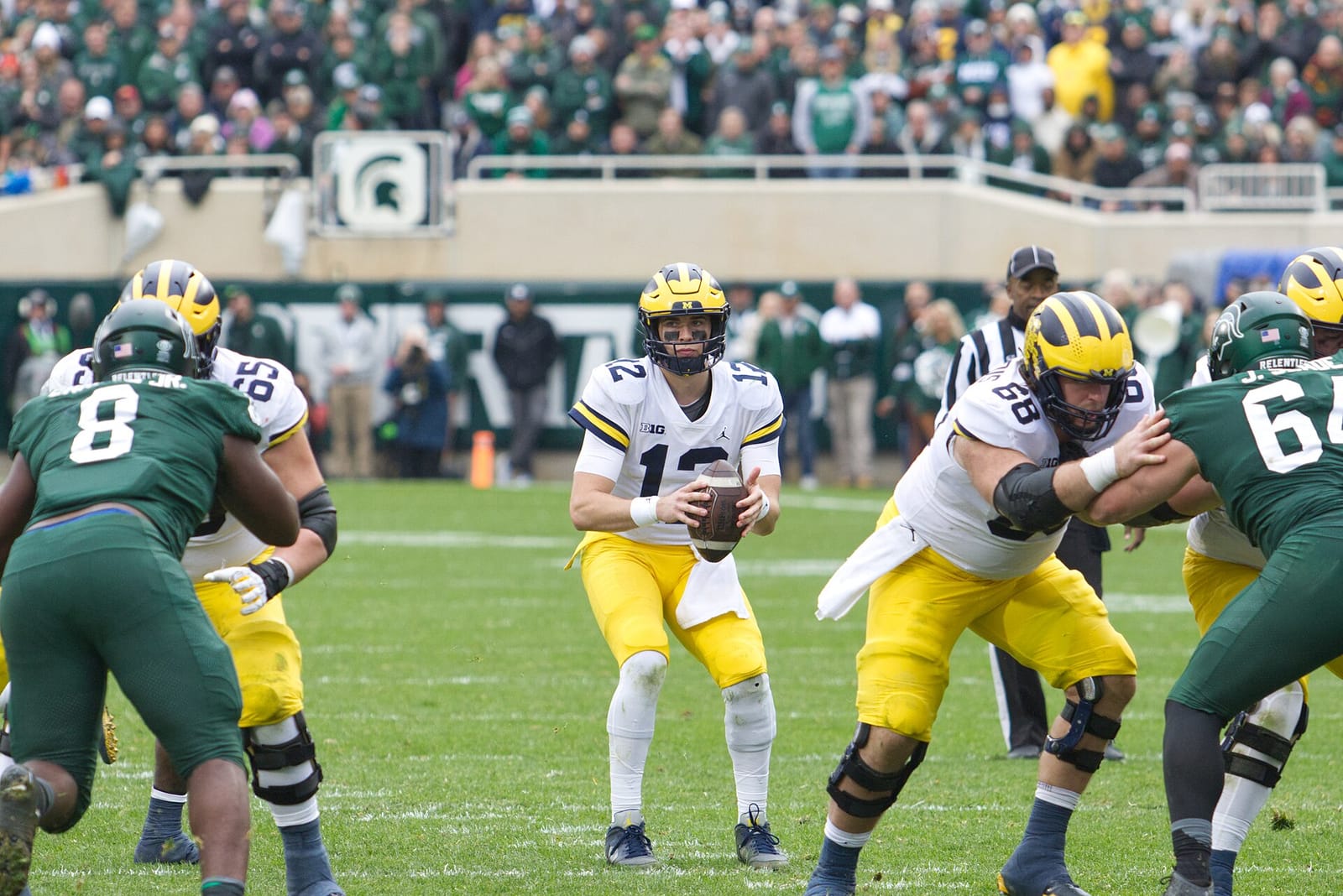
The first winged game was against Michigan State, and the rivalry still pairs the wings with green and white. Michigan at Michigan State, October 30, 2021. Photo: Maize & Blue Nation, via Wikimedia Commons, CC BY 2.0
1937 Or 1938?
You will sometimes see 1937 given as the first year. One Bentley Historical Library page, its uniforms history for 1900 to 1949, refers to the "introduction of the winged helmet in 1937." The Bentley's own helmet history, its page on Crisler, and mgoblue.com all say 1938 and give the October 1, 1938 debut against Michigan State. Crisler did not coach Michigan until 1938, so we go with 1938.
From Leather To Plastic In 1948
In 1948, the year after Crisler's last season as coach, Michigan adopted a molded plastic helmet and carried the winged design onto it, according to the Bentley's uniforms history. From then on the wings were paint on a hard shell, with no padding behind them. They stayed anyway. A shape that began as padding on a $10 leather helmet is now 88 years old, and it is the design Michigan wears with both its navy home set and its white road set in 2026.
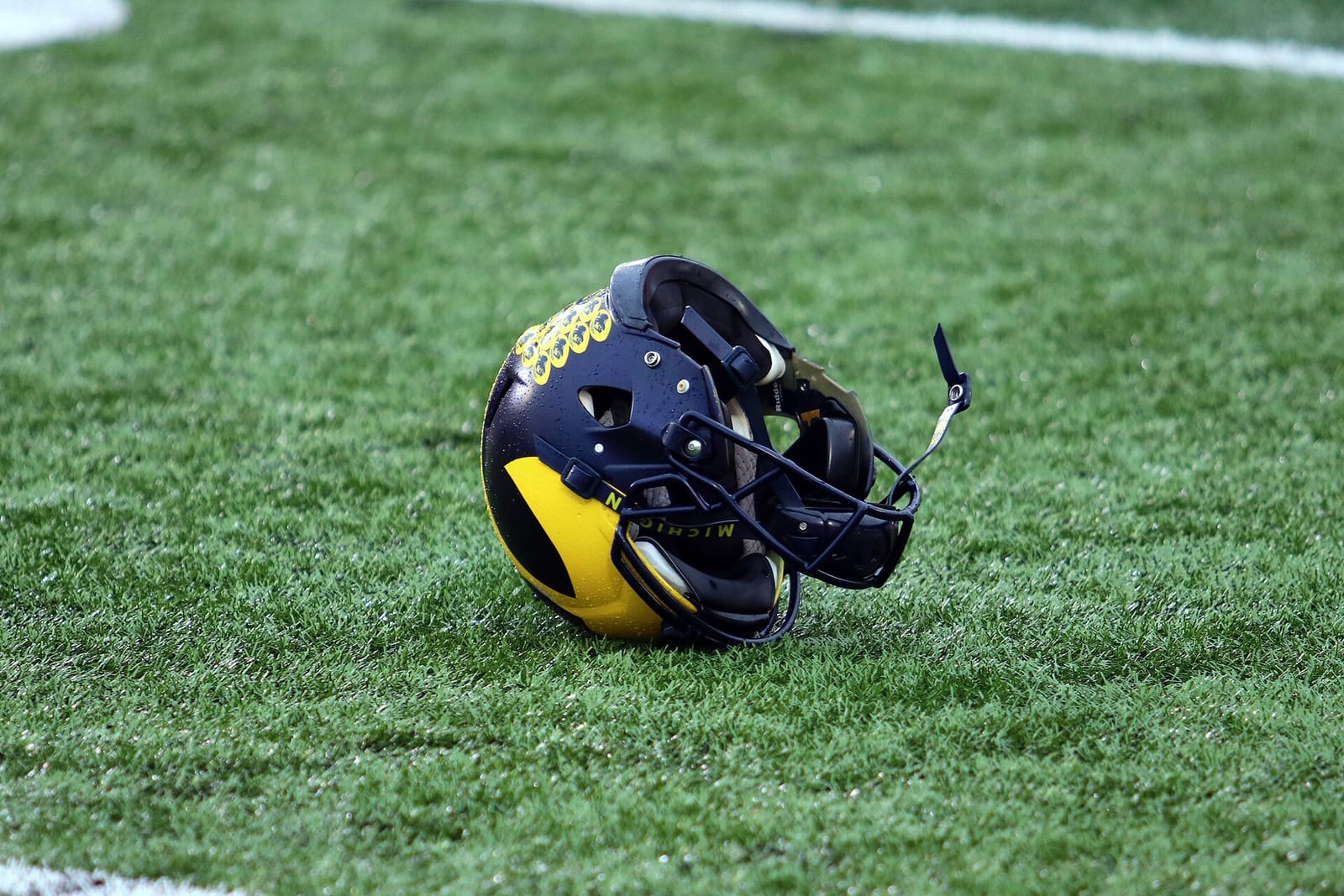
The modern plastic winged helmet on the turf, Michigan at Indiana, November 23, 2019. Photo: Maize & Blue Nation, via Wikimedia Commons, CC BY 2.0
Today: UCLA At Michigan
Michigan hosts UCLA at Michigan Stadium today, Saturday, November 21, at 3:30 p.m. ET on CBS. We expect the navy home set under the winged helmet, as listed on our Michigan 2026 uniform schedule. The full slate is in our college football Week 12 uniform guide, and UCLA's side is on the UCLA 2026 uniform schedule. Next week is Ohio State, and that preview is here: Ohio State vs. Michigan uniforms for The Game.
Our Take
Most famous helmets were drawn by someone trying to make a logo. Michigan's was not. It is the outline of a piece of leather that held a helmet together, painted bright so a halfback could find his man. That is why it still works: it fits the shape of a helmet because it came from one. Every attempt at a modern helmet "graphic" in college football is trying to look the way this one looks by accident. Best helmet in the sport.
Frequently Asked Questions
Why does Michigan's helmet have wings?
The wing shape came from the Spalding leather helmet Michigan used, where it was a padded piece that bound the ear flaps to the crown. In 1938 coach Fritz Crisler painted it maize and blue so his passers could find receivers downfield.
When did Michigan start wearing the winged helmet?
In 1938, Crisler's first season. The first game in it was October 1, 1938, against Michigan State.
Who designed the Michigan winged helmet?
Fritz Crisler brought it from Princeton, where he had introduced a similar helmet in 1935. The shape itself came from Spalding's leather helmet design; Crisler's contribution was the paint.
Is the Michigan helmet copied from Princeton?
In a sense. Crisler called it "the same basic helmet I had designed at Princeton," as quoted by mgoblue.com. Both came from the same kind of Spalding leather helmet.
What was the first game Michigan wore the winged helmet?
The 1938 opener against Michigan State on October 1. Michigan won 14-0 on two touchdown runs by Paul Kromer. None of the newspaper accounts mentioned the new helmet, according to the Bentley Historical Library.
What helmet did Michigan wear before the wings?
A plain black leather helmet, the same basic design it had worn since the 1920s. Many other schools wore the same black or brown helmet.
Were the Michigan wings originally padding?
Yes. On the Spalding FH5, the wing "provided additional protective padding and helped bind the earpieces to the crown," according to the Bentley Historical Library.
How much did the original winged helmet cost?
The Spalding FH5 was advertised at $10.00 each in the 1937 Official Intercollegiate Football Guide, in tan and black leather.
Why did Crisler put the wings on every player and not only receivers?
Some teams put colored helmets on their receivers only. Crisler thought that helped the defense just as much, according to the Bentley history, so every Michigan player got the wings.
Did the winged helmet help Michigan's passing game?
The numbers moved the right way. Michigan's passing yardage nearly doubled from 1937 to 1938, and its interceptions were cut nearly in half.
Did Michigan State wear a winged helmet first?
Michigan State adopted its own Spalding winged helmet several years before 1938, according to the Bentley Historical Library, and it was on the field for Michigan's first winged game.
When did Michigan switch to a plastic helmet?
In 1948. Michigan adopted a molded plastic helmet that year and kept the winged design.
Did Gerald Ford wear the winged helmet?
No. Ford played for Michigan from 1932 to 1934, before the wings. The Ford Presidential Museum holds a plain leather helmet it believes he wore.
How long has Michigan worn the winged helmet?
88 seasons, from 1938 to 2026.
What colors are the Michigan helmet?
Maize wings and stripes on a navy blue shell.
What is Michigan wearing against UCLA?
We expect the navy home set with the winged helmet at Michigan Stadium on Saturday, November 21. Our Michigan 2026 uniform schedule updates once the look is confirmed.
More Michigan Uniform Coverage
- Michigan 2026 uniform schedule: every game's look and result
- Ohio State vs. Michigan: The Game uniforms
- College football Week 12 uniforms
- Michigan State 2026 uniform schedule
- UCLA 2026 uniform schedule
Sources: Bentley Historical Library, University of Michigan, "Michigan's Winged Helmet" (Internet Archive copy, December 2, 2024; live page), "Uniforms 1900-1949" and Fritz Crisler; mgoblue.com, "Michigan Winged Helmet" (July 20, 2009); Gerald R. Ford Presidential Museum artifact record (via the Internet Archive); ESPN for the November 21, 2026 kickoff time and network. ColorWay Sports is an independent design site and is not affiliated with, endorsed by, or sponsored by the University of Michigan.